 Mia Chen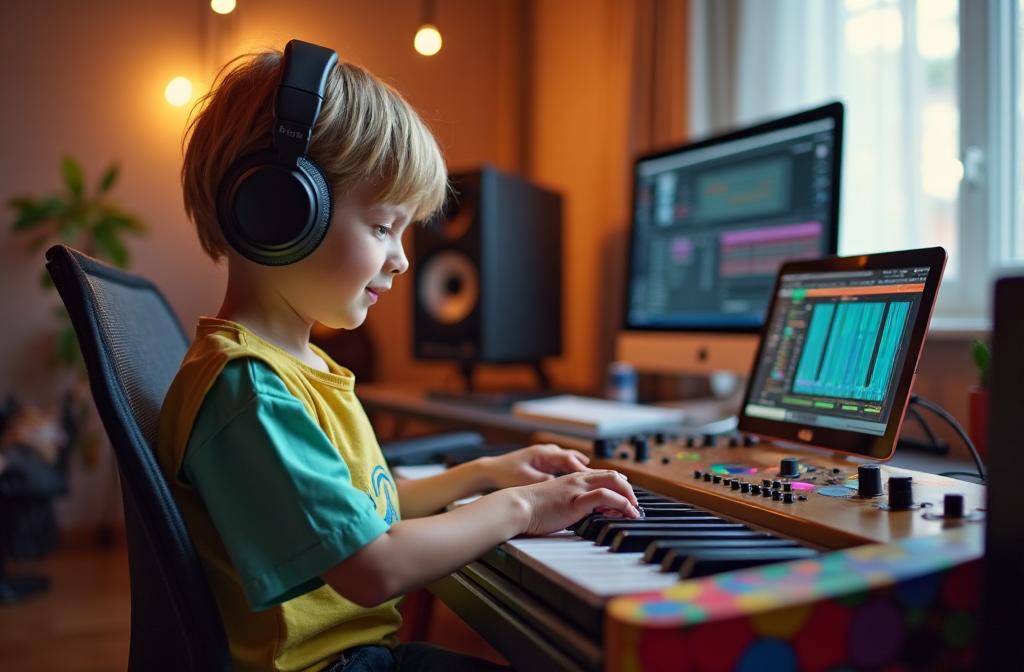
The Neuroscience Behind Music
When children create music, they engage auditory, motor, visual, and emotional brain centres simultaneously. fMRI studies show that young musicians develop stronger connections between brain hemispheres, particularly in the corpus callosum - the bridge between left and right brain. This enhanced connectivity doesn't just improve musical ability - it creates neural pathways that benefit language processing, mathematical reasoning, and spatial awareness. The brains of children who make music are literally more connected than those who don't.
Beyond Just 'Being Musical'
The cognitive benefits of music-making extend far beyond music itself. Children who regularly create music show improvements in language processing, mathematical reasoning, working memory, and emotional regulation. These gains persist even after they stop formal music training. A landmark study from Northwestern University found that children with just two years of music-making showed measurably better neural responses to speech sounds - an advantage that helped them learn to read faster and process language more efficiently.
Memory and Working Capacity
Creating music is one of the most demanding activities for working memory. A child playing a simple melody must simultaneously remember the notes, control their timing, listen to the output, and plan what comes next. This multi-layered cognitive load strengthens working memory capacity - the mental 'scratchpad' that's essential for everything from reading comprehension to maths problem-solving. Studies show that children who make music regularly have working memory capacities 15–20% larger than their non-musical peers.
Emotional Intelligence Through Sound
Music is one of the most direct pathways to emotional understanding. When children compose a 'happy' melody or a 'scary' sound effect, they're learning to identify, express, and modulate emotions through an abstract medium. This is the foundation of emotional intelligence. Kids who struggle to verbalise their feelings often find music a more natural channel for emotional expression. Beat-making, in particular, can be deeply therapeutic - the physical act of creating rhythm has been shown to reduce anxiety and improve mood regulation.
Digital Music Tools for Kids
You don't need expensive instruments to get started. Digital beat makers, loop stations, and composition tools let kids experiment with rhythm, melody, and harmony using just a browser. The barrier to entry has never been lower, and the creative ceiling has never been higher. Tools like our Beat Lab offer immediate gratification - kids can create a professional-sounding beat within minutes - while still teaching musical concepts like tempo, key, and structure. This instant feedback loop keeps motivation high.
The Social Dimension
Music-making is inherently social. Even when a child creates alone, they're participating in a cultural tradition of expression and communication. When kids share their beats, collaborate on compositions, or perform for family, they develop confidence, empathy, and a sense of belonging. Group music-making - whether in a band, a choir, or a collaborative digital project - teaches synchronisation, listening, compromise, and shared achievement. These social skills are difficult to develop through individual academic work.
Starting a Musical Practice
The best time to start is now. Begin with simple rhythm activities - clapping patterns, body percussion, drumming on surfaces. Move to digital tools that offer instant feedback and no wrong notes. Gradually introduce melody and harmony as confidence builds. Most importantly, keep it playful. The moment music-making feels like practice or homework, the neurological benefits diminish because the emotional engagement - the part that makes music uniquely powerful for brain development - disappears. Let kids play with sound freely, and the learning follows.
 James Lee
 Sara Kim
 Alex Rivera