Sara Kim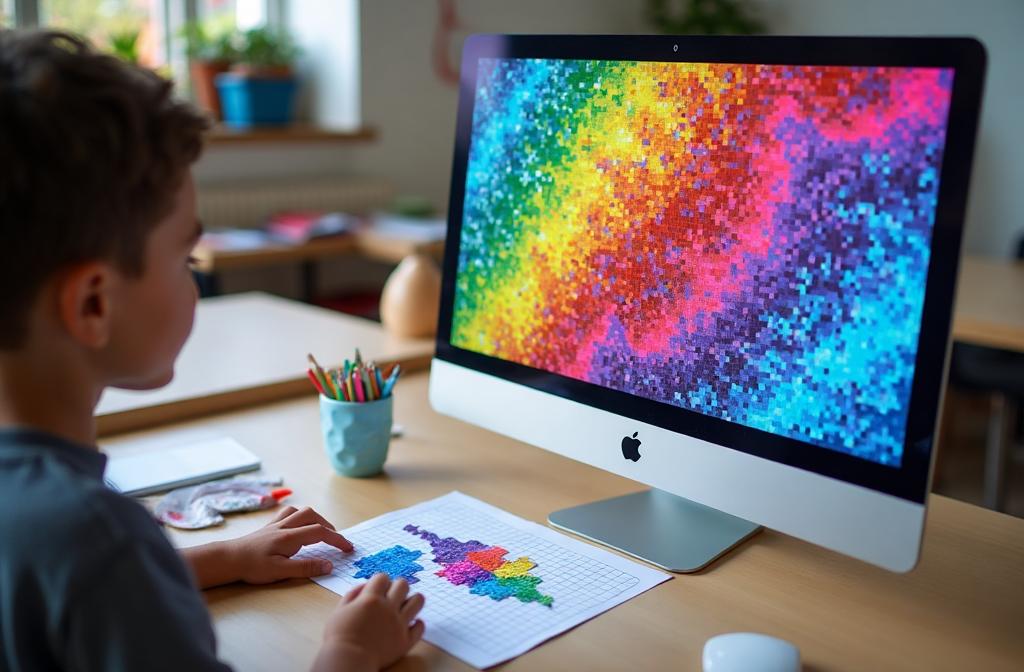
Grids Are Everywhere
When kids work with pixel art, they're learning to think in coordinate systems. Every pixel has a position - that's basically a (x, y) coordinate. This grid-based thinking is foundational for maths, geography, and even biology (think cell structures and periodic tables). Spreadsheets, maps, chess boards, and calendars are all grid-based systems that children will encounter throughout school and life. Pixel art builds familiarity with this universal organisational pattern in a context that feels playful rather than academic.
Colour Theory in Practice
Pixel art forces deliberate colour choices because you work with limited palettes. Kids naturally learn about complementary colours, contrast, and how to create depth with just a few shades. These are the same principles taught in art school, but discovered through play. When a child realises that placing a lighter shade next to a darker one creates the illusion of a light source, they've independently discovered shading - a concept that takes weeks to teach in traditional art classes. The constraints of pixel art accelerate learning by narrowing the decision space.
Computational Thinking
Creating a pixel art character requires decomposition (breaking a complex image into tiny squares), pattern recognition (repeated elements like symmetry), and abstraction (representing a whole object with minimal detail). These are core computational thinking skills that transfer directly to coding and problem-solving. When a child decides that four carefully placed pixels can represent an eye, they're practising abstraction at a level that directly prepares them for programming concepts like functions and variables.
Symmetry and Geometry
Most pixel art characters use symmetry - and kids discover this naturally. 'If I colour this pixel on the left, I need to colour the matching one on the right.' This is reflection symmetry in action. More advanced pixel artists learn rotational symmetry, tessellation patterns, and even basic transformations (flip, rotate, scale). These geometric concepts come alive when they serve a creative purpose rather than appearing as isolated maths problems on a worksheet.
Constraints Breed Creativity
One of the most powerful educational aspects of pixel art is the constraint. Working with a 16x16 grid and 8 colours might sound limiting, but constraints are actually creativity catalysts. Research from the University of Amsterdam shows that creative output increases when people face moderate constraints. Kids must think harder about every single pixel - does it represent a nose, a shadow, or empty space? This deliberate decision-making process builds critical thinking skills that transfer to writing (choosing the right word), science (designing experiments), and everyday problem-solving.
Cross-Curricular Connections
Pixel art connects naturally to almost every school subject. In maths, it teaches area, perimeter, and coordinate geometry. In science, it mirrors how digital displays work (screens are literally grids of pixels). In history, it connects to the evolution of visual communication from cave paintings to digital art. In computing, it introduces binary representation - how images are stored as data. Teachers who integrate pixel art into their curriculum report higher engagement and better retention of concepts across subjects.
From Pixel Art to Career Skills
Pixel art isn't just nostalgic - it's a thriving professional field. Indie game development, UI design, digital illustration, and even fashion design use pixel art aesthetics. Kids who develop pixel art skills are building a creative portfolio and learning transferable design principles: composition, colour harmony, visual storytelling, and attention to detail. The discipline of working pixel-by-pixel teaches a level of precision and patience that serves children well in any future career path.

 Mia Chen
 James Lee
 Alex Rivera